Revealing competitive interfacial reactions in high-energy Li-S batteries
Charge transfer at solid–liquid interfaces plays a critical role in various energy-storage systems1, particularly under dynamically varying reactant concentrations. Deciphering the...
News Desk
Staff Writer
Published
Jun 18, 2026
Source
Nature
Analytics
0 0 0
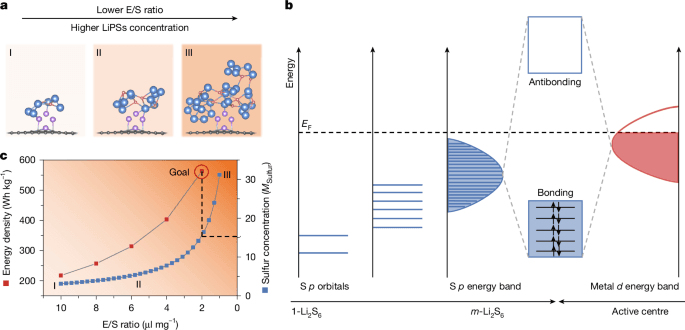
AI Insight:New research sheds light on the crucial dynamics of charge transfer at interfaces in high-energy Li-S batteries.
Charge transfer at solid–liquid interfaces plays a critical role in various energy-storage systems1, particularly under dynamically varying reactant concentrations. Deciphering the mechanisms governing these interactions is essential for the development of efficient and stable energy storage devices. Recent studies have focused on understanding the complex interfacial reactions in lithium-sulfur (Li-S) batteries, which have shown great promise due to their high energy density and potential for cost-effective large-scale implementation. However, the competitive nature of these reactions has hindered the widespread adoption of Li-S batteries, leading to inconsistent performance and reduced cycle life. By investigating the interplay between different interfacial reactions, researchers have gained valuable insights into the underlying mechanisms driving charge transfer in Li-S batteries. This knowledge can be leveraged to design novel electrochemical interfaces that optimize energy storage and utilization, ultimately paving the way for the practical realization of high-energy Li-S batteries.